Pages

Showing posts with label Winter 2016. Show all posts

Friday, March 18, 2016

The Water Clock 5000

In the last unit of Light Sound and Time, we talked about time. We learned a lot about different ways to tell time. We focused mainly on unorthodox ways of telling time such as a sundial, time zones, and a pendulum. We had the opportunity to visit the Chicago Lighthouse which is an organization that helps people who are blind. Inside their building, they have a factory where they make clocks for federal buildings around the country. For the Action Project in this unit, I had to design my own time telling device. I decided to create a water clock that descends from the clepsydra. It was tricky at first to figure out what kind of device I wanted to make. I am proud of the device I designed and I think that it came out looking exactly how I wanted it to look.
_________________________________________________________________________________

Many cultures decided to create a water clock after they realized that the sundial was not very useful since it could only be used in sunlight. The first water clock or the clepsydra was seen in 1500 BC, inside the tomb of the Egyptian pharaoh Amenhotep I. There were two types: outflow and inflow. The inflow water clocks were small bowls that were placed above a large basin of water. In the small bowl, there was a hole in the center which would flow the water into the larger bowl. The clock’s attendant would have to check in periodically and once the tub was filled to a certain point, he would have to let everyone know that an interval of time had passed. He would then empty the large tub and let the clock reset. The outflow water clocks were similar to the inflow in the sense that they both used dripping water, but this version would only have one bowl of water with lines of measurement on the inside that would leak at a steady pace. After a while, the attendant would measure the remaining water in the bowl according to the lines and that way he would know how much time has passed. The clepsydra can be used as a timer or a clock. This clock was mainly used to time speeches in courts in Athens. For example, "Some Athenian sources indicate that the water clock was used during the speeches of various well-known Greeks, including Aristotle, Aristophanes the playwright, and Demosthenes the statesman," (Ḏḥwty, The Ancient Invention of the Water Clock). The water clock also prevented people’s speeches from running too long. Depending on the type of speech or trial that was going on, different amounts of water would be put into the bowls. My device and the klepsydra are related in the sense that they both use water. My clock however can not act as a timer, only a clock.

The device I created is a large box. It is not something that you can take around but maybe later in production if it is successful there could be a handheld version. My device measures minutes and hours. There are 12 tubes on the top, in the middle there is a section filled with water, and then at the bottom there are 60 tubes. Depending on the time, the corresponding tubes would fill up with water. For example, if it was 4:34, the 4th tube on the top would be filled while the other ones are empty and 34 tubes on the bottom would be filled while the rest are empty. There are also different colored lights in each of the tubes so that each one can light up to show you the time as well. My device is an unorthodox clock. It isn’t just your generic wall clock, it incorporates water to show the time. My water clock is better because it would be incredibly accurate, it would be a mix of a digital and analog clock since there are no minute hands.

My device applies the concept of pi because my device uses a lot of circles. The height of all 12 cylinders on the top of my device is 8 and the radius is 2. In order to calculate the volume of this, I had to multiply π 2^2 x 8 = 100.53 For the cylinders on the bottom, the radius is also 2 but the height is 6. In order to calculate the volume of these tubes, I had to multiply π 2^2 x 6 = 75.4 . The circumference of the circle on top of all the tubes is  π4 ( the equation is pi x diameter and since the radius is 2, 2+2=4) which equals 4 or approximately 12.5.


Works Cited:

Mintz, Daniel. "Timekeeping in the Ancient World: Water-clocks." Water-clocks. N.p., Apr. 2007. Web. 17 Mar. 2016. <http://www-groups.dcs.st-and.ac.uk/history/HistTopics/Water_clocks.html>.

Ḏḥwty. "The Ancient Invention of the Water Clock." Ancient Origins. N.p., 3 July 2014. Web. 17 Mar. 2016. <http://www.ancient-origins.net/ancient-technology/ancient-invention-water-clock-001818>.

Thursday, March 17, 2016

Tales of Racial Discrimination

In the last unit of the Argument class, we were asked to take a position on an issue, identify our opposition and seek a solution through synthesis. In this unit, we learned about synthesis which is the resolution or solution to an argument. We looked into the fight for Civil Rights and the different arguments that come with it. The hardest part of this AP was figuring out which topic I wanted to take a stance on. There are so many oppositions in America right now that it was extremely hard to chose. I learned a lot about the country I live in and how there are still people who are so stuck in the past that they still agree with discriminatory ideology. Enjoy!


Tales of Racial Discrimination 

Thesis:
The definition of police brutality is the use of excessive and/or unnecessary force by police when dealing with civilians. “Excessive use of force” describes a force well beyond what would be necessary in order to handle a situation, for example, firing 24 shots at an unarmed suspect who is running away from an officer. In the Declaration of Independence, our country states that all men are created equal, yet there are still people getting arrested or killed just because of the color of their skin. When it comes to the issue of police brutality, I believe that all law enforcement officials, especially police officers, should be required to wear body-cams when on-duty. This way, there are fewer opportunities for cops to get away with wrongfully injuring or murdering suspects or individuals they encounter.

Evidence:
Look at people like Donald Trump or the KKK, they are real human beings who still think that one race is inferior to another. The 50th anniversary of the Civil Rights Act was a couple years ago and although people say we have come far, to me it feels like we are traveling back in the wrong direction. This country isn't going to last for very much longer if this ideology is still present. The number of people who feel like this is only growing with each Trump rally, or KKK meeting. This matters to me on a personal level because I am half black and half white. I have witnessed racism first-hand and I have seen the damage it can do. The US advocates for every person of every race to be free, but when citizens try to change that, our local and state government doesn't seem to do much to stop them. It is a proven fact that “A black man is three times more likely to be searched at a traffic stop, and six times more likely to go jail than a white person” (Jeff Nesbit, USNews). Racism in any form needs to be stopped. To go into further detail about this topic, police violence against black Americans has become a nation-wide problem.

The line between black and white is so thick that children are getting exposed to it the minute they are born, and in ways that are punitive. For example, “Black preschoolers are far more likely to be suspended than white children. Black children make up 18 percent of the pre-school population, but represent almost half of all out-of-school suspensions,” (Jeff Nesbit, USNews). In murder cases like Laquan McDonald, Eric Garner, Michael Brown, Sandra Bland, and many others, these young people’s lives were cut short by a policeman for no reason. The dash cams that are currently found on police cars are terrible quality and can be tampered with, as appears to have occurred in the McDonald murder in Chicago. Evidence can be deleted and changed, which is why most of these cops don’t end up being charged with murder. Body cams would help give a better insight about the actual incident so no one can get away with murder. In the McDonald case, “A police dashcam video from last October clearly showed the African-American teenager walking away from police when Officer Jason Van Dyke unloaded his gun, striking Laquan 16 times.” (Marilyn Rhames, Huffington Post). It was completely unnecessary to shoot this teen 16 times; a friendly reminder that the mayor didn’t release the video for over a year after the killing happened (ABC 7). The people that we hire to keep us safe need to be checked out to make sure that we are putting the right people in charge of protecting our country.

Antithesis:
The opposition believes that although police killing innocent people is a terrible problem in today’s society, body cams are not going to change that. Some crime officials state that “body cameras are seen as an invasion of privacy, as they provide state-owned footage. When police cameras are on, they will capture everyday civilian and police behavior that does not necessarily need to be recorded. Do all defendants want their arrests recorded? Do all bystanders want to be in those videos when shown in court?” (Eric Baum, Newsmax).

Evidence:
The opposition says that this will not solve anything because these cameras can still be tampered with which would keep us stuck in the place we are at right now with this problem. In the case of Rodney King, an African American man who was beaten to death by white police officers in Los Angeles in 1991, a witness named George Holliday recorded the incident which was then broadcasted around the country. The officers claimed that King was resisting arrest but it was clear in the video that the police officers were in fact beating him harder than what was needed. The police on trial said that King was on PCP at the time of the killing. In court that was proven to be mistaken, but the cops were still acquitted. Although body cams might be helpful in some cases, it is not reasonable to equip the entire police force with them; this technology is expensive. The country does not have enough money to pay for these. It just isn’t plausible. The opposition might also feel that trying to attack racism in this way is futile, claiming that black people are going to continue to get oppressed no matter what we do to stop it. Police need to be watched, but not with body cams. Racism is clearly still going to happen no matter what, but we as citizens of the USA should try to promote fairness and equality in our society.

Synthesis:
Both sides can agree that the violence that has been going on is a problem. People are getting killed for no reason and that needs to be stopped, and racism as a whole should be stopped. Both sides can also agree that police need to be watched and checked to make sure our country is putting the right people in charge.

The synthesis for these two arguments would allow mandatory background checks on police. There would also be a better quality dash cam that will record everything and make sure cops can’t get away with murder. I do agree with the opposition that body cams may not a plausible solution. If that is the case, then citizens should be able to record police if they witness a case of brutality and upload their video evidence directly to a non-biased police review board. Also, racism in schools and jobs needs to be lessened. There should be equal opportunities for everyone. The color of your skin should not determine how much money you make. If a white person and a black person are doing the same job, they should be paid equally. The opposition agrees that racism could be stopped for good in America. If these changes were implemented, it would allow for a more fair and just country.

Questions for the Opposition:
1. Why are innocent black lives not as important as other races?
2. Where is all of the money that could be used for these cameras going?
3. Should it be legal for people to record police?

Questions the Opposition Might Have for me:
1. Why should police who are truthful and trustworthy be forced to wear body cams?
2. Why should civilians’ privacy be invaded by body cams?
3. Since body cams also be tampered with, wouldn’t we remain where we are now?


Works Cited:
Bail Set at $1.5 Milllion for Chicago Police Officer Jason Van Dyke, Charged in Laquan McDonald Shooting." ABC7 Chicago. ABC7, 30 Nov. 2015. Web. 17 Mar. 2016. <http://abc7chicago.com/news/jason-van-dyke-posts-bond-leaves-jail/1103665/>.
Baum, Eric. "5 Pros and Cons of Police Wearing Body Cameras." Newsmax. N.p., 30 June 2015. Web. 16 Mar. 2016.
Nesbit, Jeff. "America, Racial Bias Does Exist." US News. U.S.News & World Report, 13 Jan. 2015. Web. 14 Mar. 2016.
Nesbit, Jeff. "Institutional Racism Is Our Way of Life." US News. U.S.News & World Report, 6 May 2015. Web. 14 Mar. 2016.

Milligan, Susan. "The Struggle Goes On." US News. U.S.News & World Report, 28 Apr. 2015. Web. 14 Mar. 2016

Rhames, Marilyn. "Laquan McDonald and What My Dying Father Told Me About the Chicago Police." The Huffington Post. TheHuffingtonPost.com, 10 Dec. 2015. Web. 15 Mar. 2016.

Vertesi, Janet. "The Problem With Police Body Cameras." Time. Time, 4 May 2015. Web. 16 Mar. 2016. <http://time.com/3843157/the-problem-with-police-body-cameras/>.

Wednesday, March 9, 2016

The Cellphone Debate


For our second Action Project in the Argument course, we were asked to take a look at the GCE Code of Conduct and amend one of the rules. In this unit we talked a lot about the Constitution and Declaration of Independence and how both establish arguments. The purpose of this Action Project was to show the flawed logic behind a rule in the school Code of Conduct that students have to abide by. I am proud of how I remade the rule that I amended. I think that it takes very important things that go along with it into consideration. Newly amended, the rule will help benefit the school community. It was challenging to figure out which rule I was going to pick, but I am glad I chose the one that I did.
_________________________________________________________________________________
Paper Shredders- You Get What You Pay For!, Trudy. Your Organized World. Sept. 12, 2012.

This picture reprints the metaphor of if you are using a piece of paper to do something school- related, and a teach assumes you are using it for other reasons so they immediately take it. If you can show that you are responsible to use your phone for school related things, you should have the option to.

The GCE Code of Conduct is filled with a bunch of different types of rules with sections including, truancy, plagiarism, dress code . The rule I chose to ammend states that we as students are not permitted to use cellphones in class, yet so many people do. The rule reads:

The use of electronic devices during class time or Field Experience, unless specifically authorized by the teacher for class work, is prohibited. Cell phone use is allowed between classes and during lunch. It also states that If a student uses his/her cell phone in class , the following disciplinary actions will be taken: First time- ­device into ‘class bin’ until the end of the class, second time- school personnel will retain cell phone until the end of the day, third time- ­school personnel will retain the device until parent/guardian claims it. If a student uses his/her cell phone during an FE, the following disciplinary actions will be taken: First time-­ verbal warning from FE Leader's), second time-­ FE Leader/s will retain cell phone until the end of the day, third time- ­school personnel will retain the device until parent/guardian claims it.

Deconstructed into a formal argument, this rule is:

P1: Using cellphones in class without authorization is against the Code of Conduct.

P2: Students are not permitted to use cell phones on FE unless authorized.

C: Students who use cell phones without authorization are subject to their cell phone being taken until the end of the day.

Students may need to use their phones to record something, send themselves a reminder, etc. Some students need their phones in case of a problem or emergency with their family. Students should also be able to take calls if they know they are important. If there is a case of a family emergency and someone calls the student, s/he should be allowed to check their phone. If the student knows it is out of the ordinary for them to be getting a call during school, they should have the right to check it. Students who have been deemed trustworthy should also able to use their phones if necessary. My rule change as a formal argument would be as follows:

P1: A student can only use their phone in case of emergency.

P2: This student must be one who is known to be trustworthy and will not use their phone to go on social media, text, etc. (unless there is an emergency).

C: Trustworthy students can use their phones for emergencies or class/FE use only.

To better understand my argument, consider the following situation: If someone is using a piece of paper to write things down, and someone else comes and takes it from them with the excuse that it is against the rules to use this piece of paper, it would not be fair. The paper is that person’s property and no one should be able to take that and assume that they are using it for something other than school when they aren’t. The paper being used is the person’s property. They are using it for a reason to benefit them in school. This goes along with cell phones because cell phones are a student's property.

If the current rule was changed, students will be able to use their phones in class when there is an emergency. There have been many times when students get an unexpected call, but they were not allowed to answer it. With my proposed amendment, students will be allowed to use their phones if needed. My argument has some supporters already. According to student DR, “When there is a time where access to a computer isn't well, accessible, there is some contradiction in the Code of Conduct because without my phone, my production and participation in class would be almost absent. Sure, phones can be a distraction for some students, but with the right guidelines and rules, phones should be permitted. For some students, phones are a savior.” DR raises another great reason for why my amendment is needed when he refers to the tech challenges students sometimes face and their inability to have a working laptop at all times

The rule that I am amending follows closest to the first amendment which states that “the making of any law respecting an establishment of religion, impeding the free exercise of religion, abridging the freedom of speech, infringing on the freedom of the press, interfering with the right to peaceably assemble or prohibiting the petitioning for a governmental redress of grievances is prohibited.” This amendment represents the rule I chose to change because students have a right to use their own property. Students own their phones, they should be able to use them if need be. Teachers should not be allowed to dictate if they can use them, especially in emergency situations. I understand that students need to focus, and they should not be able to use cell phones just to go on social media or text, but I think that people should be able to use their phones if necessary. This amendment will help benefit the school community because it places more trust in students.

Wednesday, March 2, 2016

The Diddley Bow Experiment

In the second unit of Light, Sound and Time, we learned about sound and how to create it. We learned about the different waves that sound can create and what they look like. For the action project, we were asked to build an instrument and explain how it works and how it relates to some of the science and math topics we covered in this unit. One thing I struggled with was getting my string around my screws. It is very difficult to bend and wrap a guitar string around a screw so it took me a while to finally get it. I also struggled with creating a good sound. I am proud of how my guitar came out. I think that the pitch of my guitar came out really nice and I think the design I created worked well for me. If I could do this project all over again, I would get a thicker wire and get a thicker board so that the screws wouldn’t go through the board and potentially stab someone.

MF (2016). Diddley Bow. 

I built a diddley bow which is a variation of a guitar. I created this to show that it is nice to get a professionally made guitar but it's equally nice to build one yourself so you can see your work and you can know what it feels like to create something. There is a small town in Paraguay called Cateura and it is built completely on a landfill and the people there have taken it upon themselves to create instruments made out of the garbage that they find around their town. There is a documentary about Cateura called The Landfill Harmonic and they have done amazing work and have toured around the world to show kids and adults how you can make something out of nothing.

My diddley bow demonstrates many of the science principles we talked about in this unit. The pitch of the instrument is based on how much tension your wire has, how long it is, and the material of it. When something plucks the string, it vibrates a creates a tiny wave that reaches the tin can then vibrates that creating a sound. The amplitude differs depending on how hard or soft you pluck the string.

MF (2016). Diddley Bow (Back). 

MF (2016). Diddley Bow (Front). 

My guitar produces sound through the tin can. Plucking the string makes it vibrate against the can causing a sound. In order to create a sound, the string has to be extremely tight so I tied my string around two screws, screwed them all the way into the wood and then placed a battery in between two screws so that it would be even tighter. The tin can’s circular shape amplifies the sound when the string is plucked. When using a slide on my guitar, it can change the note rapidly. Using the slide makes the wave shorter. If I place a finger on the string, I can hear two notes: the original note and a higher/lower note.

To create my guitar, I used a wood board, a thin guitar string, a nine volt battery, screws, and a tin can. I poked a hole in my tin can by hammering a screw into it, then I ran my string through the hole and tied it to the screws placed on opposite sides of the board. For tuning pegs, I used screws, and for a nut I used a nine volt battery. I put a screw on either side of the battery and the tin can to keep them in place. The width of my guitar string is 0.84 mm.


MF (2016). Diagram 

I used a can with a diameter of 7 centimeters, which means the radius is 3.5, and a height of 11 centimeters. This means that the volume is 3.14 x (r^2) x heigh t= 3.14 x (3.5^2) x 11= 423.115 cubic centimeters.

The Doppler Effect is the idea that a sound gets a higher or lower pitch as it moves closer or farther from the observer. If someone were to play my guitar and two people were on either side of the player, the person that the player is going towards would hear a higher frequency, and the person that is farther away would hear a lower frequency.

The part of the string on my guitar that vibrates is 24 centimeters long. My open note is G4 with a frequency of 392 hertz and a wavelength of 88.01 centimeters. Below, you can see the approximate first 4 harmonics of my guitar:


MF (2016). Guitar Harmonics Visual

MF (2016). Harmonic Drawing

Monday, February 15, 2016

The Rights That We Deserve


In the first unit of the Argument class, we talked about what an argument is and what it is made up of. We focused on the elements of an argument and how we can craft one. We took a look at the Declaration of Independence and fully analyzed the argument that it makes. For this action project we were asked to create a class that could be taught at school. I chose to create a class about human rights called The Rights That We Deserve. I want students to learn about what rights they have and when it is important for them to know and use them. Something I struggled with was a creative title. I am proud of my course and I think that it could have real potential. I hope you enjoy my declaration.
_________________________________________________________________

MF. Human Rights, 2016
All human beings need to understand their rights. There are so many instances where people in power violate and ignore the rights of people “below” them like in the case of a Lane Tech student who was arrested for a crime he did not commit just because his skin color matched that of the real crook. When he was arrested, he was not read his Miranda rights and when he tried to protest, they didn’t listen. Citizens of this nation need to learn what rights they have. Human rights are an incredibly huge part of being human. They make or break us and can save our lives in some cases. They can keep us out of prison and can keep us safe.

The purpose of school is to educate people on things that they need to know in order to succeed. School is a place of people teaching other people about different things they need to know. It is a place for people of all different ages to come together to learn and teach one another about the basics of life. Learning is extremely important to our mind and soul because it helps us better ourselves by showing us things we didn't know and helping us achieve our goals. Whether it’s learning a math equation or just how to speak better, everything makes a difference. Our unalienable rights are life, liberty, and the pursuit of happiness. In The Rights That We Deserve, we will be diving deep into the rights we as Americans have as well as looking into current events that use these rights and the rights of different countries. All around the world there are places that have no rights or rights that are not being recognized by the government like the Democratic Republic of Congo, Palestine, Syria and many others. This class will show us that we need to take into consideration our rights that we have and how we as Americans are lucky that we have any rights at all. Our rights at GCE are to be able to explore and learn things that will lead us in the direction we want to go in with our lives. GCE helps us become better people. Talking about current events is a way to better your understanding of what's going on and there have been plenty of cases having to do with people in power not recognizing other people’s rights. For example with all of the police shootings that have been going on, the police just took the lives of innocent people without hesitation and without warning. This is something that a lot of people have had serious discussions about that are worth paying attention to. If people don’t know their rights, this will continue to happen.

My guiding question for this course is when is it important to know our human rights? We as humans need to understand the rights we have and when it is important to know/use them like if we are in a situation with police they have to read you your Miranda rights or else you can not be tried, this can make or break a case. I want this to be a summer emersion class for outgoing juniors- incoming seniors so that they will be able to understand their human rights according to the constitution and the declaration and be able to explain them so they can prepare for their senior year humanities classes. If someone is passionate about something, they should be able to speak freely about whatever it is without worry of restriction. For this class we can partner with a lot of different organizations that specialize in human rights such as International Federation for Human Rights, International Foundation for Human Rights and Tolerance International, Freedom of Expression Exchange, Heartland Alliance, The Human Rights Watch etc. These organizations can explain to students about the fight for rights in America and in different places around the globe. The Human Rights Watch (based in Chicago) hosts annual trips to different countries that are struggling to help them get back on their feet. This would be a great opportunity for the students to experience some things first hand.

For the first unit of the course of The Rights That We Deserve, I want to focus on America's rights, for the second I want to focus on the rights that other countries around the world may or may not have, specifically The Congo, Syria, and Palestine. The third unit would be a comparison of the rights we as Americans have and how they differ from other countries. One of the action projects could be protesting something or declaring something they are passionate about while another could be envisioning what it would be like to try to protest something in another country that may not have the same rights as us. . I want the students to do some research on current events having to do with human rights and find a way to let a big group of people know about it. I want the students to have a chance to get up and talk to a group of people about something they are passionate about. There are many documentaries about human rights such as Call Me Kuchu, The Farm: Angola, USA, The Thin Blue Line, and many more; these are all available on netflix.


I declare that we should have a class on human rights. We need to understand the things that we have a right to and how we can access those. We need to realize that even though our rights are not noticed all of the time, there are some countries whose rights are never noticed and I really want to shed light on that so students can understand the rights that we have and how we are fortunate to have them at all.

Tuesday, February 9, 2016

Pinhole Camera


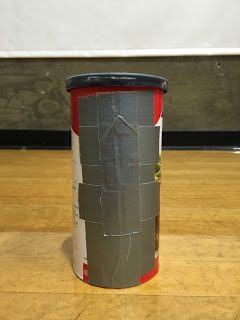
For the first action project in the Light, Sound, and Time class, we were asked to create a pinhole camera and take an image with it. The first unit of this class was called Light. We focused on different light waves and how they work. We went into depth about what kind of light waves there are in the universe and the math that goes along with it. We talked about the electromagnetic spectrum and the different waves you can measure using it and the way colors work. When it came to colors, we focused on the way colors are absorbed and reflected. I learned a lot about waves and the different parts of them and how to measure those. We covered a lot of math and it was all very helpful and useful and I think that I understood it all. This action project is about the way light can be used to take an image and the way that a dark room can create an image itself. The camera itself is just a cardboard canister and it can take an actual picture. I am very proud of the way my camera turned out.
__________________________________________________________________________

Pinhole With Cover. MF, 2016.

Pinhole Without Cover. MF, 2015
My pinhole camera captures light through a small hole in the aluminum. Depending on how big the hole is, the more light will go into the cardboard canister. The light will reflect the image onto the photo paper inside and the paper will show the photo once we develop it. While it does capture light, it is not an example of refraction. This is because as the rays pass through the lens, they don’t meet and come into contact with another medium so they are not refracting.


The camera I created was based on an experiment where the camera was as big as a wall and the room was completely black. The inside is black so you can control how much lights goes into the cardboard canister.The color black absorbs light while the color white reflects it. This is important because the photo paper is very light sensitive so in order for the image to come out, there needs to be no light getting in until you open the shutter. This camera ties into a lot of things we learned in this unit. It demonstrates the wave vs particle idea because it has light waves that pass through the small hole in the tin while it also leave particles behind in order for the image to show up. The light coming into the hole makes an image which uses energy. The electromagnetic spectrum is used because there are a lot of different light waves that come in through the hole.


The distance from my lens to my photo paper is 3.5 inches, the height of my pinhole is 4 inches. I decided to photograph my water bottle and the height of that is 10 inches, and the minimum distance away my camera can be in order to take a good picture is 5.25 inches.


Similar Triangles

My picture did not end up coming out but I still think that it was a great experience and I'm happy I got to try out creating a pinhole camera and developing a picture from it. I think my camera was not 100% light proof. I don't think that I painted the black on thick enough so a little bit of light was getting into the sides. If I were to do this again, I would want to make sure that my canister was completely black inside and that no light could get in except through the pinhole.


Pinhole Fail. MF, 2016.


Works Cited:

Theme, Pinhole. "The Pinhole Gallery." The Pinhole Gallery. Wordpress, 2016. Web. 16 Feb. 2016.