Pages

Showing posts with label LST. Show all posts

Friday, March 18, 2016

The Water Clock 5000

In the last unit of Light Sound and Time, we talked about time. We learned a lot about different ways to tell time. We focused mainly on unorthodox ways of telling time such as a sundial, time zones, and a pendulum. We had the opportunity to visit the Chicago Lighthouse which is an organization that helps people who are blind. Inside their building, they have a factory where they make clocks for federal buildings around the country. For the Action Project in this unit, I had to design my own time telling device. I decided to create a water clock that descends from the clepsydra. It was tricky at first to figure out what kind of device I wanted to make. I am proud of the device I designed and I think that it came out looking exactly how I wanted it to look.
_________________________________________________________________________________

Many cultures decided to create a water clock after they realized that the sundial was not very useful since it could only be used in sunlight. The first water clock or the clepsydra was seen in 1500 BC, inside the tomb of the Egyptian pharaoh Amenhotep I. There were two types: outflow and inflow. The inflow water clocks were small bowls that were placed above a large basin of water. In the small bowl, there was a hole in the center which would flow the water into the larger bowl. The clock’s attendant would have to check in periodically and once the tub was filled to a certain point, he would have to let everyone know that an interval of time had passed. He would then empty the large tub and let the clock reset. The outflow water clocks were similar to the inflow in the sense that they both used dripping water, but this version would only have one bowl of water with lines of measurement on the inside that would leak at a steady pace. After a while, the attendant would measure the remaining water in the bowl according to the lines and that way he would know how much time has passed. The clepsydra can be used as a timer or a clock. This clock was mainly used to time speeches in courts in Athens. For example, "Some Athenian sources indicate that the water clock was used during the speeches of various well-known Greeks, including Aristotle, Aristophanes the playwright, and Demosthenes the statesman," (Ḏḥwty, The Ancient Invention of the Water Clock). The water clock also prevented people’s speeches from running too long. Depending on the type of speech or trial that was going on, different amounts of water would be put into the bowls. My device and the klepsydra are related in the sense that they both use water. My clock however can not act as a timer, only a clock.

The device I created is a large box. It is not something that you can take around but maybe later in production if it is successful there could be a handheld version. My device measures minutes and hours. There are 12 tubes on the top, in the middle there is a section filled with water, and then at the bottom there are 60 tubes. Depending on the time, the corresponding tubes would fill up with water. For example, if it was 4:34, the 4th tube on the top would be filled while the other ones are empty and 34 tubes on the bottom would be filled while the rest are empty. There are also different colored lights in each of the tubes so that each one can light up to show you the time as well. My device is an unorthodox clock. It isn’t just your generic wall clock, it incorporates water to show the time. My water clock is better because it would be incredibly accurate, it would be a mix of a digital and analog clock since there are no minute hands.

My device applies the concept of pi because my device uses a lot of circles. The height of all 12 cylinders on the top of my device is 8 and the radius is 2. In order to calculate the volume of this, I had to multiply π 2^2 x 8 = 100.53 For the cylinders on the bottom, the radius is also 2 but the height is 6. In order to calculate the volume of these tubes, I had to multiply π 2^2 x 6 = 75.4 . The circumference of the circle on top of all the tubes is  π4 ( the equation is pi x diameter and since the radius is 2, 2+2=4) which equals 4 or approximately 12.5.


Works Cited:

Mintz, Daniel. "Timekeeping in the Ancient World: Water-clocks." Water-clocks. N.p., Apr. 2007. Web. 17 Mar. 2016. <http://www-groups.dcs.st-and.ac.uk/history/HistTopics/Water_clocks.html>.

Ḏḥwty. "The Ancient Invention of the Water Clock." Ancient Origins. N.p., 3 July 2014. Web. 17 Mar. 2016. <http://www.ancient-origins.net/ancient-technology/ancient-invention-water-clock-001818>.

Wednesday, March 2, 2016

The Diddley Bow Experiment

In the second unit of Light, Sound and Time, we learned about sound and how to create it. We learned about the different waves that sound can create and what they look like. For the action project, we were asked to build an instrument and explain how it works and how it relates to some of the science and math topics we covered in this unit. One thing I struggled with was getting my string around my screws. It is very difficult to bend and wrap a guitar string around a screw so it took me a while to finally get it. I also struggled with creating a good sound. I am proud of how my guitar came out. I think that the pitch of my guitar came out really nice and I think the design I created worked well for me. If I could do this project all over again, I would get a thicker wire and get a thicker board so that the screws wouldn’t go through the board and potentially stab someone.

MF (2016). Diddley Bow. 

I built a diddley bow which is a variation of a guitar. I created this to show that it is nice to get a professionally made guitar but it's equally nice to build one yourself so you can see your work and you can know what it feels like to create something. There is a small town in Paraguay called Cateura and it is built completely on a landfill and the people there have taken it upon themselves to create instruments made out of the garbage that they find around their town. There is a documentary about Cateura called The Landfill Harmonic and they have done amazing work and have toured around the world to show kids and adults how you can make something out of nothing.

My diddley bow demonstrates many of the science principles we talked about in this unit. The pitch of the instrument is based on how much tension your wire has, how long it is, and the material of it. When something plucks the string, it vibrates a creates a tiny wave that reaches the tin can then vibrates that creating a sound. The amplitude differs depending on how hard or soft you pluck the string.

MF (2016). Diddley Bow (Back). 

MF (2016). Diddley Bow (Front). 

My guitar produces sound through the tin can. Plucking the string makes it vibrate against the can causing a sound. In order to create a sound, the string has to be extremely tight so I tied my string around two screws, screwed them all the way into the wood and then placed a battery in between two screws so that it would be even tighter. The tin can’s circular shape amplifies the sound when the string is plucked. When using a slide on my guitar, it can change the note rapidly. Using the slide makes the wave shorter. If I place a finger on the string, I can hear two notes: the original note and a higher/lower note.

To create my guitar, I used a wood board, a thin guitar string, a nine volt battery, screws, and a tin can. I poked a hole in my tin can by hammering a screw into it, then I ran my string through the hole and tied it to the screws placed on opposite sides of the board. For tuning pegs, I used screws, and for a nut I used a nine volt battery. I put a screw on either side of the battery and the tin can to keep them in place. The width of my guitar string is 0.84 mm.


MF (2016). Diagram 

I used a can with a diameter of 7 centimeters, which means the radius is 3.5, and a height of 11 centimeters. This means that the volume is 3.14 x (r^2) x heigh t= 3.14 x (3.5^2) x 11= 423.115 cubic centimeters.

The Doppler Effect is the idea that a sound gets a higher or lower pitch as it moves closer or farther from the observer. If someone were to play my guitar and two people were on either side of the player, the person that the player is going towards would hear a higher frequency, and the person that is farther away would hear a lower frequency.

The part of the string on my guitar that vibrates is 24 centimeters long. My open note is G4 with a frequency of 392 hertz and a wavelength of 88.01 centimeters. Below, you can see the approximate first 4 harmonics of my guitar:


MF (2016). Guitar Harmonics Visual

MF (2016). Harmonic Drawing

Tuesday, February 9, 2016

Pinhole Camera


For the first action project in the Light, Sound, and Time class, we were asked to create a pinhole camera and take an image with it. The first unit of this class was called Light. We focused on different light waves and how they work. We went into depth about what kind of light waves there are in the universe and the math that goes along with it. We talked about the electromagnetic spectrum and the different waves you can measure using it and the way colors work. When it came to colors, we focused on the way colors are absorbed and reflected. I learned a lot about waves and the different parts of them and how to measure those. We covered a lot of math and it was all very helpful and useful and I think that I understood it all. This action project is about the way light can be used to take an image and the way that a dark room can create an image itself. The camera itself is just a cardboard canister and it can take an actual picture. I am very proud of the way my camera turned out.
__________________________________________________________________________

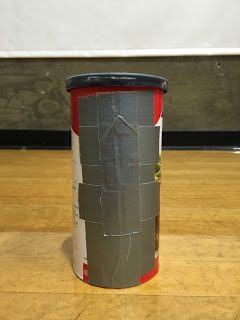
Pinhole With Cover. MF, 2016.

Pinhole Without Cover. MF, 2015
My pinhole camera captures light through a small hole in the aluminum. Depending on how big the hole is, the more light will go into the cardboard canister. The light will reflect the image onto the photo paper inside and the paper will show the photo once we develop it. While it does capture light, it is not an example of refraction. This is because as the rays pass through the lens, they don’t meet and come into contact with another medium so they are not refracting.


The camera I created was based on an experiment where the camera was as big as a wall and the room was completely black. The inside is black so you can control how much lights goes into the cardboard canister.The color black absorbs light while the color white reflects it. This is important because the photo paper is very light sensitive so in order for the image to come out, there needs to be no light getting in until you open the shutter. This camera ties into a lot of things we learned in this unit. It demonstrates the wave vs particle idea because it has light waves that pass through the small hole in the tin while it also leave particles behind in order for the image to show up. The light coming into the hole makes an image which uses energy. The electromagnetic spectrum is used because there are a lot of different light waves that come in through the hole.


The distance from my lens to my photo paper is 3.5 inches, the height of my pinhole is 4 inches. I decided to photograph my water bottle and the height of that is 10 inches, and the minimum distance away my camera can be in order to take a good picture is 5.25 inches.


Similar Triangles

My picture did not end up coming out but I still think that it was a great experience and I'm happy I got to try out creating a pinhole camera and developing a picture from it. I think my camera was not 100% light proof. I don't think that I painted the black on thick enough so a little bit of light was getting into the sides. If I were to do this again, I would want to make sure that my canister was completely black inside and that no light could get in except through the pinhole.


Pinhole Fail. MF, 2016.


Works Cited:

Theme, Pinhole. "The Pinhole Gallery." The Pinhole Gallery. Wordpress, 2016. Web. 16 Feb. 2016.